


Deforming arthrosis most often affects the joints of the lower limbs, one of which is the ankle.These joints have great mobility in different planes and perform an important function when walking (rolling the foot and transferring the weight of the body from the heel to the toes), and also bear the weight of the human body.Osteoarthritis of the ankle joint is a kind of retribution for upright posture.But many other factors also play a certain role in the development of the disease.First, unnoticed by the patient, the cartilaginous shell of the joint begins to soften and thin, then cracks, which causes the inflammatory process and the growth of bone tissue in the form of osteophytes.With advanced arthrosis, a person cannot move without support and experiences severe pain, especially when leaning on the leg.Disability is possible within a few years of the onset of the disease, if timely and comprehensive treatment is not started.
Reasons for the development of the disease
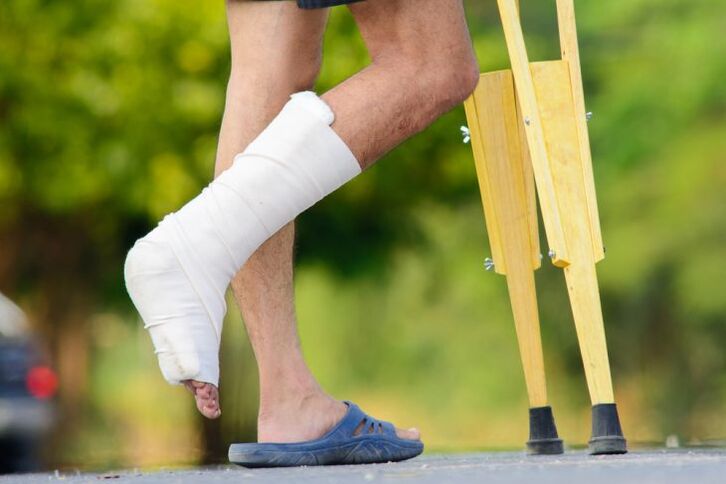
Previous injuries to the ankle joint increase the likelihood of developing a degenerative process in it.
- Increased body weight;
- Flat feet, congenital deformities of the foot (cauda, flat feet);
- Metabolic disorders in diseases such as diabetes, gout, atherosclerosis of the blood vessels of the legs;
- Previous injuries to the joints, for example, damage to the ligament apparatus, fractures of the ankles and bones of the legs;
- Constant overloading of the joint, which leads to microtraumas (in athletes and people carrying heavy loads);
- Hereditary predisposition to arthrosis of the joints;
- Previous inflammation of the joint (arthritis) of an infectious nature or in systemic diseases (rheumatoid, psoriatic, gouty arthritis).
Depending on the absence or presence of a specific factor that caused the disease, ankle arthrosis can be primary or secondary.There is also a division into stages.If stage 1 is present, a person is able to work;if arthrosis has progressed to stages 2 and 3, pain and limited mobility lead to disability (temporary or total).
Symptoms of arthrosis of the ankle
- "Startup" pain.This is one of the early symptoms of ankle arthrosis.The pain occurs after prolonged sitting when trying to lean on the leg and may be accompanied by short-term stiffness of movement in the joint.After a few steps the pain disappears;
- Pain during and after physical activity;
- Pain at night associated with an inflammatory process that is triggered due to the destruction of cartilage tissue;
- Cracking, clicking in the joint when moving;
- Swelling, especially noticeable under the ankles;
- Restriction of movements;
- Hypotrophy of the periarticular muscles and weakness of the ligament apparatus due to the fact that a person begins to spare the sick leg;
- Joint deformation in the last stage of arthrosis.
Diagnosis
It is necessary to distinguish arthrosis and its exacerbation from various inflammatory processes in the joint, for example, as a result of rheumatoid gout or psoriatic arthritis.Therefore, the doctor prescribes a detailed blood test, rheumatoid tests, CRP and uric acid test.In arthrosis, these indicators are normal, but if the disease is in an acute stage, ESR and leukocytes may increase.To establish the stage of arthrosis and obtain more detailed information about the pathology, radiography in 2 projections, ultrasound, CT or MRI of the joint is used.An X-ray may show a slight narrowing of the joint space if the osteoarthritis is in stage 1. When progressing to stage 2, the joint space is reduced by 40% or more than normal.And at the 3rd stage, it is significantly narrowed, it can be practically absent, visible bone growths and deformations.
Methods of treatment
Arthrosis of the ankle joint, as well as other localizations, requires complex, long-term and course treatment.
- Unloading the ankle joint during a period of severe exacerbation (walking with a cane on the side of the healthy limb), using a bandage;
- Eliminate shock loads (jumping, running), vibrations, lifting weights, long standing periods;
- Body weight control;
- Quit smoking;
- Wearing a semi-rigid orthosis with accompanying joint instability;
- Physiotherapy (UHF, SMT, laser therapy, magnetotherapy);
- Drug therapy:
- NSAIDs external, oral, injection;
- glucocorticoids together with anesthetics intra-articularly and peri-articularly to relieve inflammation;
- vascular means;
- muscle relaxants to eliminate spasm of muscle tissue;
- chondroprotectors - intra-articular drugs are more effective.If it is not possible to obtain intra-articular injections, intramuscular administration or oral administration is indicated;
- preparations with hyaluronic acid to restore the quality of the synovial fluid.
- Orthopedic insoles, wearing comfortable shoes with a small heel;
- Gymnastics for strengthening the muscle-ligament apparatus.The suggested exercises should be performed daily:
- lying down or sitting, bend and straighten your toes 10 times;
- lying down or sitting, pull your legs towards you and away from you 10 times;
- rotate your legs outward and inward 10 times;
- make circular movements with your legs clockwise and counterclockwise 10 times;
- sitting on a chair, put your feet on the floor with your toes and heels together, alternately move your legs forward and backward, repeat 15-20 times.
- Swimming, water aerobics;
- In the third stage of arthrosis and the ineffectiveness of conservative treatment, endoprosthesis of the ankle joint or removal of the destroyed cartilage shell and joint capsule with its closure using a rod structure or Ilizarov apparatus (arthrodesis) is indicated.
Prevention

To reduce the risk of developing arthrosis, preference should be given to foods with a high protein content in the diet and spicy, salty, fried foods and alcohol should be excluded from the diet.
- Avoid joint injuries.To do this, you should try not to wear shoes with unstable heels or too hard soles and use special protective equipment when playing sports;
- Body weight control;
- You must adhere to a diet, that is, eat more protein-rich foods and refrain from salty, spicy, fried and alcohol;
- Timely treatment and correction of metabolic disorders, endocrine and vascular diseases;
- Perform the above exercises for the ankle joints.
The effectiveness of the treatment of deforming arthrosis of the ankle joint depends on the stage of its development and the presence of concomitant diseases.In any case, if conservative therapy is indicated, it should include medication and physical methods, as well as correction with orthopedic products.
Which doctor should I contact?
If you have pain in the ankle joint, you should consult a rheumatologist.The doctor will prescribe exercises, medicines and identify the cause of the disease.If you have diabetes or gout, it will be helpful to see an endocrinologist;if you have atherosclerosis of the vessels of the lower extremities, it will be useful to visit a vascular surgeon and a cardiologist.An orthopedist plays an important role in treatment - he will not only help you choose the right shoes and orthopedic insoles, but will also perform surgery if necessary.If you are overweight, you should be examined by a nutritionist and choose the right diet.Non-drug treatment is carried out with the participation of a physiotherapist.